
What is the role of sequential art, graphic novels, and comics in the English Language Arts (ELA) classroom?
In an ELA classroom, these different modes of media and language open students’ expression and understanding of text, significance in passing on stories, and art. Many students first associate stories with books, they forget other modes of communication utilized through time such as oral story telling and art. By expanding into different modes of storytelling, aside from usual textbooks and articles, students can go forward in storying telling evolution, allowing themselves more forms to sympathize and utilize for their own development of expression and comprehension.
"readers may have an easier time with the graphic novel because the pictures make the surface plot approachable while
providing a gentle nudge in the direction of the inner issues.
Graphic novels and comic books for older students frequently expose adolescents to the adult world, a world differ-
ent than their immediate world. Middle school and high school readers feel a sense of identity and begin to navigate
this seemingly foreign world of adults – a world of adult love, deception, respect and admiration, intrigue, satire,
passion, politics, war, bonds of friendship, famine, genocide, and hope. As students look at these books as accessible
(perhaps with some considering the text simple, fun and familiar) they are also developing an awareness of what is means to be an adult," said Kelly (2010).
Post reading discussion prompts I would use in my class include:
"Conferencing:
In classrooms in which students practice Reader-Response (Rosenblatt, 1965), conferences can
help teachers to monitor comprehension. After reading, a teacher can ask students to explain their
response to the text as well as ask how he/she achieved that response and can intervene when
students demonstrate difficulties with comprehension."
I would ask my students to look through “This One Summer” up to page 16, without reading the text. What can you infer from the story so far? What makes you think so? How does it change once you read the text?
"Discussion:
Asking students to discuss their responses to the text helps them to participate in communal
discussion. By utilizing discussion groups, literature circles (Daniels, 1994), or Socratic seminars,
teachers help students to negotiate meaning about a text. After working with a peer or small
group, engaging students in whole class discussions helps the class to discuss the theme of a graphic
novel, characters, plot, author technique, etc. Students can use their reading journals to ask questions, discuss connections, or raise points for discussion."
I would have them discuss pages 60-61 of “This One Summer” asking: What would these panels convey without the text? How are illustrations conveying how our narrator feels? How are text bubbles influencing how it’s read? How do these contrast to pages 70-71?
On pages 90-91, I ask what is the significance of the large bottom panel? What can we infer from the text and panels about Windy? What is the significance of the light here?
"Completing graphic organizers:
Graphic organizers such as the Venn Diagram (for comparisons), a T-Chart (for cause-and-effect
or problem-solution), the K-W-L chart (Ogle, 1986), or the Comprehension Windows Strategy
[Bass & Woo, 2008] for nonfiction or informational text can help teachers monitor student under
standing after reading."
I can have students create a graphic organizer comparing cause and effects throughout the story or comparing when panels and texts coincide or contrast meaning.
"Creating:
When students create based on what they read, they are not only demonstrating that they comprehend the text, they are also reflecting on their comprehension."
I can have students create a mural using the graphic novel’s panels in order to summarize or convey their understanding of the whole story. Furthermore, I can give them the option to create their own short story or comic inspired from the story, using its main themes and motifs.
For the last post-discussion activity, I would have students choose their own sequential art, graphic novel, comic, or novel to pair with reading “This One Summer” and share how they hold similar themes, characters, or techniques.
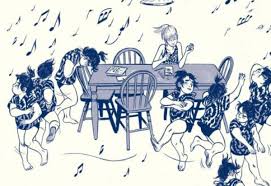
Page 70-71 of “This One Summer.”
 Jellyfish Melodies